
How to Build STAR Interview Stories That Actually Land
"Tell me about a time you disagreed with a stakeholder."
Most people don't stumble on that question because they lack experience. They stumble because they try to find a story, shape it and tell it all at once, under pressure. The fix is to do the hard part early: build a small bank of true stories and walk in knowing which one fits which question.
Here's how to do that with the STAR method, plus how to use an AI chat tool to tighten stories without letting it make anything up.
What the STAR method is (and where people go wrong)
STAR stands for Situation, Task, Action and Result. It gives a behavioral answer a beginning, a middle and an end.
- Situation: where you were and what was going on. One or two sentences.
- Task: what you were responsible for, or what had to change.
- Action: what you did, step by step. This is the heart of the answer.
- Result: what happened because of it, ideally with something you can count or compare.
The common mistakes are predictable. People spend a minute on the Situation and rush the Action. They say "we" so often that the interviewer can't tell what they did. And they end with something vague like "it went really well."
A good rule of thumb: keep the Situation and Task short, give the Action about half your time, and always land on a Result. Aim for about two minutes. If the interviewer wants more, they'll ask.
Step 1: Find your stories before you need them
You don't need 50 stories. You need a handful of strong ones that can bend to fit different questions. Most behavioral questions circle back to the same themes, such as:
- a conflict or disagreement
- a failure or a mistake you owned
- leading without formal authority
- a tough deadline
- a decision you made with data
- a process you improved
- handling change or pushback
- prioritizing when everything was urgent
For each theme, write one line: the project, the problem and what you did. Don't polish anything yet. If you're stuck, look through old status reports, retrospective notes, performance reviews, thank-you messages and your calendar from a busy quarter. Those are full of stories you've forgotten.
Career changers have more material than they think. A teacher who planned an event across three departments has a stakeholder story. Describe it in the new field's words without changing the facts.
Step 2: Write each story in STAR order
Take your strongest line for each theme and expand it under the four headings. Use short notes, not full paragraphs, so you sound natural when you say it out loud.
Here's a fictional example for "a time you handled pushback":
- Situation: A team was moving from monthly releases to two-week sprints, and two senior developers thought planning meetings were a waste of time.
- Task: As the Scrum Master, I needed the team to try the new rhythm for a fair test, not just go through the motions.
- Action: I met each developer one-on-one to hear their concerns, cut planning to a timebox they agreed to, and asked them to help design the sprint review so it showed real working software.
- Result: After three sprints, both said planning was useful, and the team chose to keep the shorter cycle.
The Action is specific, it uses "I," and the Result is easy to picture.
Step 3: Make the Result concrete (and honest)
Results are where most answers go soft. You don't need a dramatic percentage, just something specific and true. Useful kinds of results include time saved, errors reduced, money saved or earned, customer feedback, a decision that got made, a risk that didn't happen, or a team that kept a new way of working.
If you don't have an exact number, say so honestly: "about two days per release," "roughly half the rework," or "from weekly escalations to almost none." Interviewers respect a careful estimate. They don't respect a number that falls apart under one follow-up question.
Then run the "So what?" test. Read your Result and ask, "So what?" If the answer is obvious and matters to the business or the people involved, you're done. If not, add one more sentence about why it mattered.
Step 4: Map stories to questions
Now list the questions you expect, and write the story you'd use next to each one, plus a backup. "Tell me about a conflict," "Describe a time you disagreed with your manager" and "How do you handle difficult stakeholders?" can often share one story told from a slightly different angle.
This map stops the blank-mind moment. You're not searching your whole career, just picking from stories you already know.
Step 5: Practice out loud, with a short version
Say each story out loud and time it. Then make a 30-second version for quick follow-ups. If you run long, shorten the Situation.
A short AI prompt section
An AI chat tool can help you tighten a story, but only if it works from your facts. Remove names, employers and anything confidential before you paste. Then try prompts like these:
Tighten a draft:
Here are my notes for a STAR interview story: [paste notes]. Rewrite them as a spoken answer of about two minutes. Use only the facts I gave you. Do not add numbers, tools or outcomes I didn't mention. If something important is missing, list it as a question for me instead of filling it in.
Practice follow-ups:
Act as an interviewer. Ask me this behavioral question: [question]. After I answer, ask two realistic follow-up questions, one at a time. Don't answer for me.
Always read the output line by line. If it says something you can't defend in the room, take it out.
FAQ
How many STAR stories do I need? Start with one story for each of the 8 themes above. A bank of about 8 to 12 true stories is a good starting point, because one story can often answer several questions.
How long should a STAR answer be? About two minutes for a full answer, with a 30-second version ready. Spend about half of it on your actions.
What if my result doesn't have a number? Use an honest estimate, or describe a clear change: a decision made, a complaint that stopped, a practice the team kept. Specific beats impressive.
Can I reuse one story for different questions? Yes. Change which part you emphasize. A deadline story can also show prioritization or stakeholder management.
Is it okay to use AI to write my answers? Use it to tighten and practice, not to invent. Every fact should come from you, and you should be able to explain every line in a follow-up.
Want the worksheets and examples?
If you'd like a guided version of all of this, the STAR Interview Story Kit walks you through 12 common themes with Word worksheets, filled examples, 30 common questions mapped to themes and 25 AI prompts. See the STAR Interview Story Kit ($15).
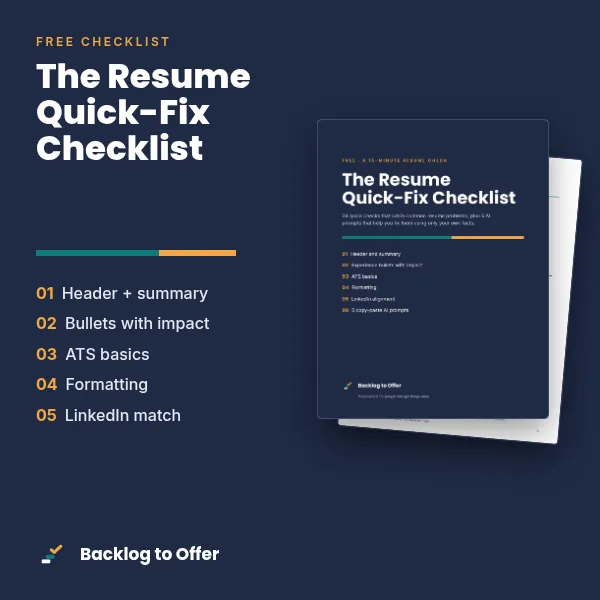
The Resume Quick-Fix Checklist
24 quick checks for your summary, bullets, ATS basics, formatting and LinkedIn, plus 5 AI prompts that use only your facts. Free, in exchange for your email.